Blogs

Discover the latest insights, trends, & innovations in digital transformation & intelligent technologies. Stay updated with expert articles, success stories, & industry-focused content from TamkeenTech.

Showing results for: "Real Time" (2 articles found)
Reset Filters

Recent Articles

Stay updated with our latest thoughts and industry news

Page 1 of 1
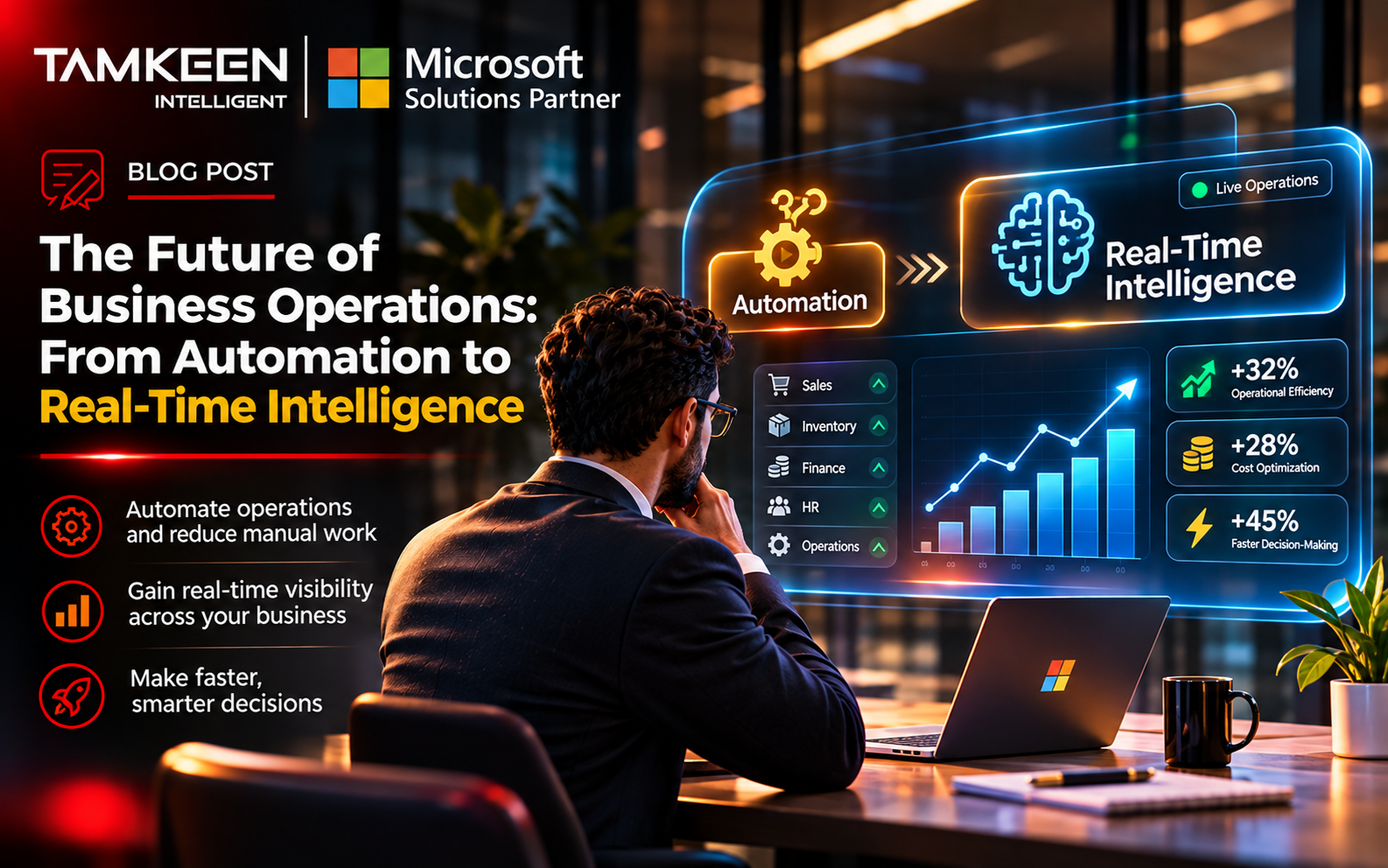
The Future of Business Operations: From Automation to Real-Time Intelligence
Nov 08, 2026 3 min read

The Future of Business Operations: From Automation to Real-Time Intelligence

For years, digital transformation focused on automation: replacing paper, reducing manual data entry, digitizing approvals, and moving processes into enterprise systems.That work remains important, but the next stage goes further. Businesses now want to understand what is happening as it happens, identify risks earlier, and give employees the information needed to act immediately.The future of operations is therefore not simply automated. It is connected, real-time, and increasingly intelligent.1. Automation Solves Tasks. Intelligence Improves Decisions.Automation is valuable when a process is predictable: route an approval, generate a document, update a record, or trigger a notification.Real-time intelligence adds another layer. It connects operational data, analytics, workflows, and AI so teams can understand changing conditions and respond faster.2. Real-Time Visibility Changes ManagementWhen information is delayed, management is forced to operate through historical reports. By the time a problem becomes visible, the opportunity to respond early may already be gone.Connected enterprise systems can give decision-makers a clearer view across finance, procurement, sales, inventory, projects, supply chain, and other operational areas. Instead of asking only “What happened?”, leaders can focus on “What is happening now?” and increasingly “What should we do next?”3. AI Is Becoming Part of the Operating ModelMicrosoft is embedding Copilot experiences and AI agents across Dynamics 365, creating new ways to analyze data, automate work, surface exceptions, and support decisions.This matters because operational intelligence is most useful when it is embedded directly into the workflows employees already use - not isolated in a separate AI experiment.4. Operations Need to Move Beyond the DeskBusiness happens everywhere. Sales teams meet customers. Project managers work on site. Executives travel. Logistics employees operate in the field. Managers need to approve requests wherever they are.A modern operating model should therefore make key processes available closer to the people who need them.5. Extending Dynamics 365 with Intelligent OperationsAt Tamkeen Intelligent, this is the idea behind our Intelligent Ecosystem and IOM - Intelligent Operations Management.IOM is designed to make essential enterprise processes more accessible while remaining connected to Microsoft Dynamics 365. It can bring together areas such as Projects, Purchasing, Finance, Sales, My Workflow, and Payment Requests so users can interact with important business processes without being tied to a traditional desktop ERP experience.6. One Connected Operating EnvironmentThe biggest opportunity comes when enterprise data, workflows, mobile access, analytics, and AI are not treated as separate initiatives.Microsoft Dynamics 365 can provide the core business-process foundation, while integrated applications, automation, and AI extend that foundation closer to everyday work. The result is an operating environment that can be more responsive, visible, and scalable.The Journey from Automation to IntelligenceDigitize the process.Connect the data.Automate repetitive work.Make information available in real time.Use AI to surface insights and exceptions.Enable people to act faster with better context.At Tamkeen Intelligent, we help organizations build toward this model by combining Microsoft Dynamics 365, intelligent business applications, automation, analytics, and AI. The objective is not simply to make existing work digital. It is to create a smarter way for the business to operate.
Tamkeen Intelligent - Nov 08, 2026
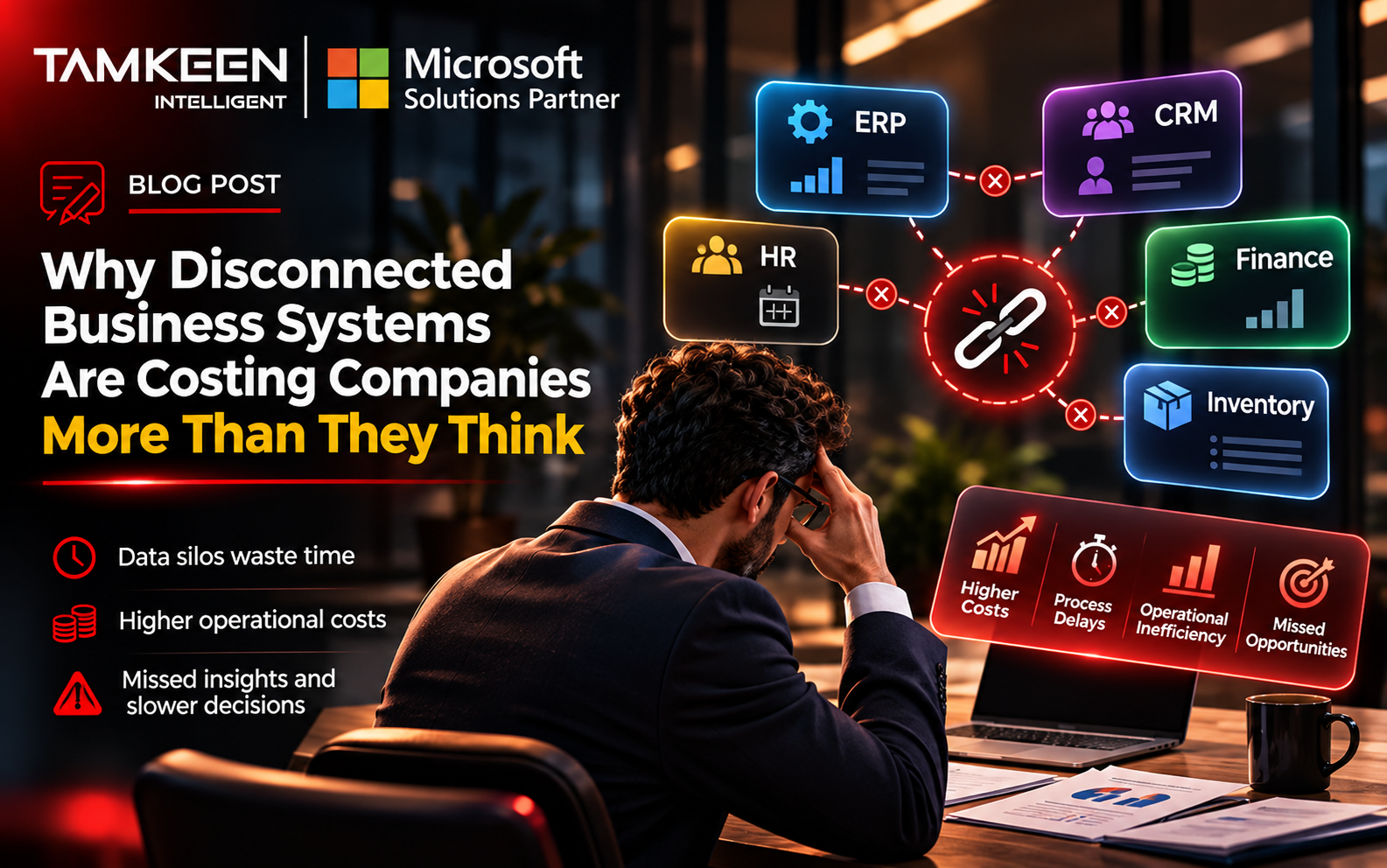
Why Disconnected Business Systems Are Costing Companies More Than They Think
Nov 01, 2026 3 min read

Why Disconnected Business Systems Are Costing Companies More Than They Think

Disconnected systems rarely look like a major business problem at first. Finance has its platform. Sales uses a CRM. Procurement relies on spreadsheets. Operations has another system. Teams find workarounds, and the business keeps moving.The real cost appears over time: duplicated work, delayed reporting, inconsistent data, manual reconciliation, weak visibility, slower approvals, and decisions made without the full picture.What looks like a technology problem eventually becomes an operational and financial problem.1. Data Silos Create Different Versions of the TruthWhen departments work from separate systems, the same customer, supplier, product, project, or financial information may exist in multiple places. Each team can end up working from a different version of the truth.Management then spends valuable time asking which report is correct instead of focusing on what the data is actually saying.2. Manual Work MultipliesDisconnected systems usually create manual bridges: exporting files, copying data between platforms, re-entering transactions, preparing reconciliation sheets, and sending approval requests through email or messaging tools.These tasks may seem small individually, but repeated across departments and months they consume significant time and introduce avoidable errors.3. Decisions Become SlowerA leadership team cannot act in real time if information first has to be collected from five systems and consolidated into a spreadsheet.Modern organizations need connected information across finance, supply chain, inventory, sales, projects, customers, and operations. Visibility should be built into the way the business operates - not recreated manually before every meeting.4. Growth Makes Fragmentation WorseA collection of disconnected tools may work for a smaller organization. As the business adds entities, locations, employees, customers, products, and transaction volumes, complexity grows quickly.Processes that once depended on individual knowledge become harder to control. Reporting becomes slower. Governance becomes more difficult. Scaling the business also means scaling the workarounds.5. Connected Platforms Change the ModelMicrosoft Dynamics 365 is designed around connected business applications across ERP and CRM. Organizations can bring together functions such as finance, supply chain, sales, service, commerce, projects, and other operations while integrating with the broader Microsoft ecosystem.The value is not simply having fewer applications. It is creating a more consistent flow of data and processes across the business.What a Connected Business Can AchieveMore consistent data across departments.Faster reporting and stronger executive visibility.Less duplicate data entry and fewer manual handoffs.Better coordination between finance and operations.A stronger foundation for automation, analytics, and AI.Greater scalability as the business grows.Integration Is Not the End GoalConnecting systems is only valuable if it improves the way people work. The objective should be to simplify processes, remove unnecessary handoffs, and make information available at the right point in the workflow.This is where digital transformation becomes a business transformation rather than an IT project.At Tamkeen Intelligent, we help organizations move away from fragmented operating models by connecting enterprise processes through Microsoft Dynamics 365 and integrated digital solutions. The goal is not technology for its own sake - it is a business environment where information can move as efficiently as the organization needs to.

Tamkeen Intelligent - Nov 01, 2026

Get a Free Consultation.

Fill up the from & our Team will get back to you within 24 hours.

Use your company email (e.g., @company.com)

What service do you want? *

City *